

Deepfake Candidates Are Now Targeting Healthcare Jobs
A hiring manager asks a candidate to turn their head 90 degrees to the side.
The face on screen glitches. What looks like a routine interview step is now a fraud check, and healthcare employers are running it more than ever.
If you have interviewed for a pharmacy or medical affairs role recently and been asked to pan your camera or wave your hand, you already know something has changed.
Healthcare hiring has become a target for AI-enabled interview fraud.
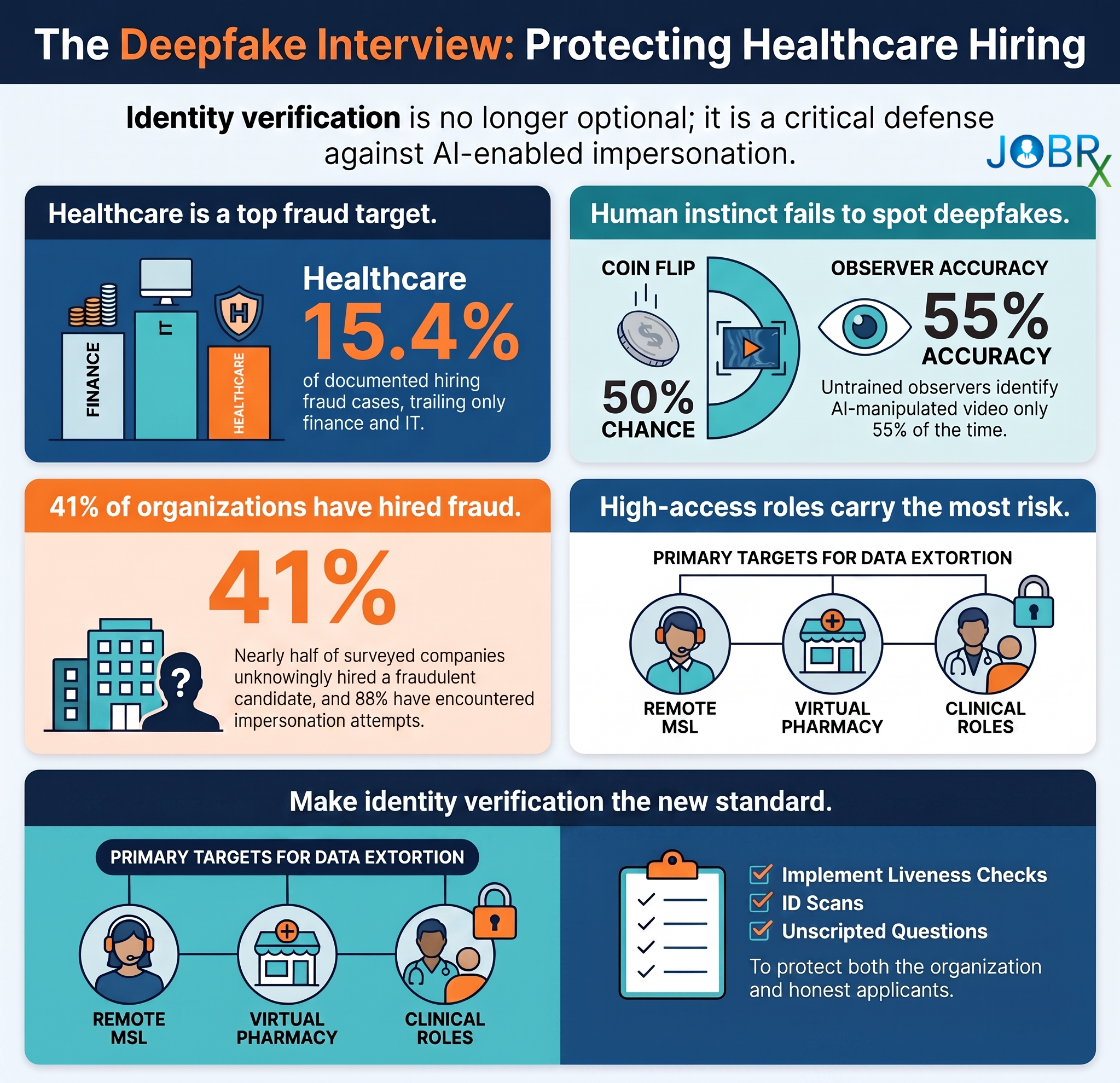
According to Yardstik’s 2025 analysis, healthcare accounts for 15.41 percent of documented hiring fraud cases, ranking third behind finance and IT.
The FBI’s Internet Crime Complaint Center issued an advisory in January 2025 warning that North Korean IT operatives use AI face-swapping technology during video interviews to secure remote roles, then extort companies for data after being hired.
For pharmacists, pharmacy technicians, and MSL candidates, this means interview processes now include identity verification steps that did not exist two years ago.
For HR leaders, Pharmacy Directors, and Medical Affairs leadership, it means hiring pipelines carry new compliance exposure.
Patient safety, controlled substance access, and proprietary clinical data all raise the stakes when the person on the other side of the screen is not who they claim to be.
Human judgment alone cannot catch this.
A Wiley meta-analysis found untrained observers correctly identify deepfakes only 55.54 percent of the time, close to a coin flip. Hiring managers relying on instinct are no longer equipped to spot manipulated video or voice on their own.
The fraud is already inside real hiring funnels.
GetReal Security, reported in Security Magazine in February 2026, found 41 percent of organizations have unknowingly hired a fraudulent candidate, and 88 percent have encountered a deepfake or impersonation attempt during hiring.
Separately, a Checkr survey of 3,000 U.S. hiring managers found 35 percent confirmed a proxy attended a virtual interview in their organization, while only 19 percent felt confident they could catch this kind of fraud.
Remote and high-access roles carry the most risk.
Gartner projects that by 2028, one in four job candidate profiles globally will be fake. Roles with system access, sensitive data, or minimal in-person contact draw the most fraudulent activity, which places remote MSL positions, virtual pharmacy consults, and distributed clinical roles squarely in the exposure zone.
Verification is becoming a standard interview stage, not an exception.
Employers are adding liveness checks, government ID scans, and unscripted follow-up questions earlier in the process.
For legitimate candidates, this is not an insult. It is quickly becoming the norm across Hospital Pharmacy Jobs, Medical Science Liaison Jobs, and Remote MSL Jobs alike.
For job seekers, this shift rewards preparation and transparency. Candidates who keep a consistent, verifiable digital presence, a professional headshot, an accurate LinkedIn history, and a resume that matches their spoken experience, will move through screening faster.
Working with legitimate Pharmacy Recruitment Services or a dedicated Pharmacist Personal Recruiting Service can also help candidates stand out, since vetted talent pipelines carry built-in credibility that cold applications do not.
For HR leaders and hiring directors, this is the moment to formalize identity verification without turning interviews into interrogations.
Clear, consistent verification steps applied to every candidate protect both the organization and honest applicants competing for Clinical Pharmacist Jobs Near Me or MSL Jobs Near Me.
Verification is not a red flag anymore. It is a professional expectation on both sides of the table. Candidates, treat consistency across your resume, interviews, and online presence as a career asset. Hiring leaders, build verification into your process early rather than reacting after a bad hire.
The organizations and candidates who adapt now will define what trustworthy hiring looks like for the rest of this decade.
Share this with a colleague navigating either side of the interview table this week.